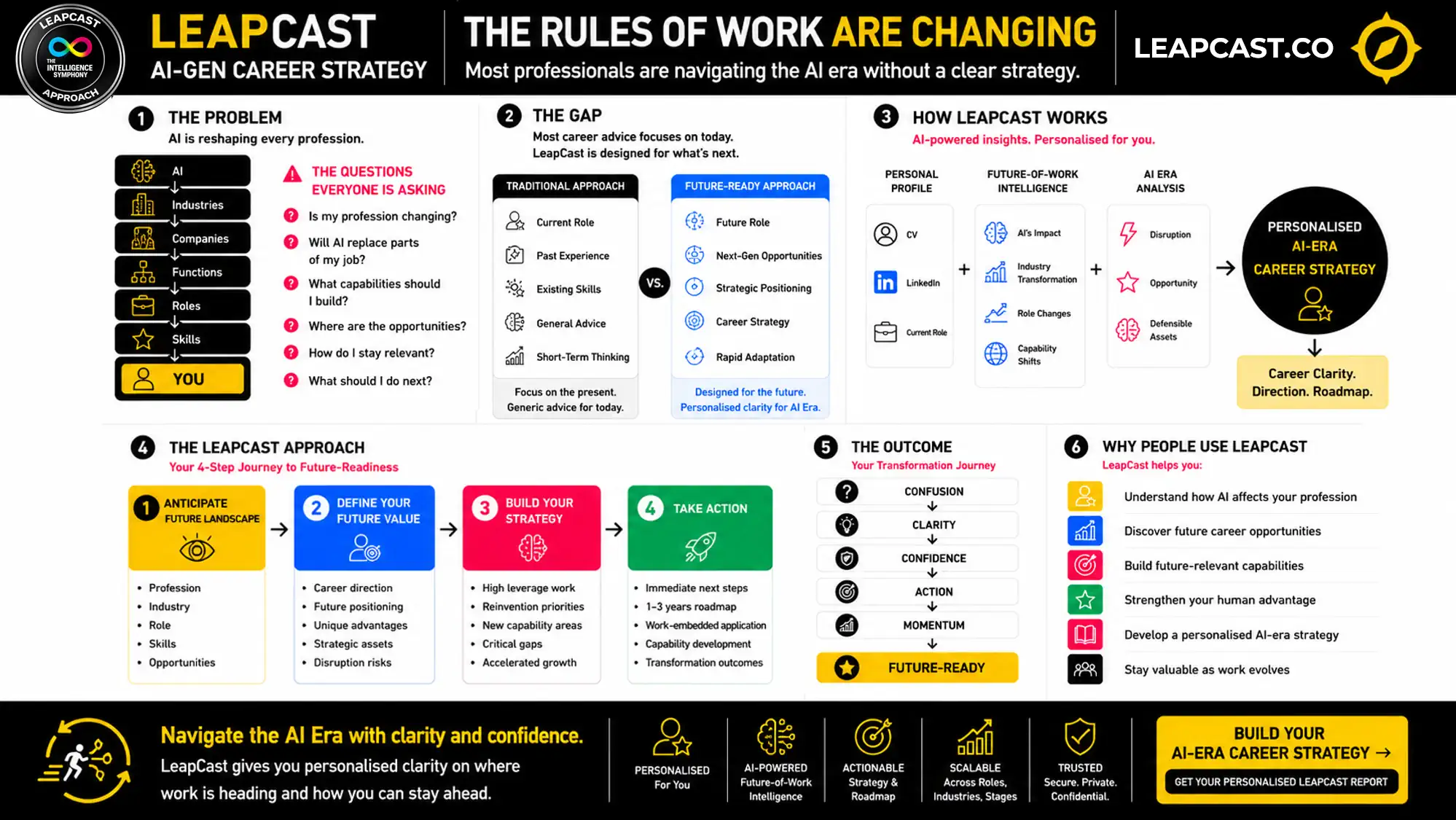
Sample AI-Generation Career Strategy

The AI-Generation Career Strategy System

Role Profile
Learning & Development Professional

A high-level preview based on a generic role profile. Your personalised strategy goes far deeper, tailored to your experience, strengths, and direction.

Build Your Personalized AI-Generation Career Strategy

  • Based on your profile (resume / LinkedIn)
  • With a fully customised Transformation Roadmap
  • Including exact capabilities to build and prioritise
๐Ÿ”˜ Get Your Personalized Report โ€” Move from insight โ†’ strategy โ†’ execution
The Intelligence Symphony
Value
โšก
Clarity in chaosCut through noise and see how AI is truly reshaping your role
๐ŸŒ
Future-grounded thinkingAnchor your decisions in where the world is actually heading
๐ŸŽฏ
Positioning over skillsFocus on where value moves, not just what to learn
๐Ÿ”บ
Strategic differentiationMove out of the replaceable middle into high-leverage roles
๐Ÿš€
Actionable transformationTurn insight into concrete career moves
The 4-Stage System
1
Stage 1
AI-Gen Future Work Landscape Understand how your role is being reshaped
2
Stage 2
AI-Gen Professional Vision Redefine who you must become
3
Stage 3
AI-Gen Career Strategy Position yourself where value is rising
4
Stage 4
AI-Gen Transformation Roadmap Turn strategy into execution
1

AI-Gen Future Work Landscape

How AI is reshaping L&D โ€” specifically
7 Shifts Redefining L&D
Shift 01

The Cost of Content Creation Collapses

Custom learning content that once took weeks and significant budget now takes hours. Value is no longer in production โ€” it's in curation, quality judgment, and instructional intelligence.

Shift 02

Speed-to-Competency Becomes a Competitive Metric

Organisations must close skill gaps in weeks, not quarters. AI-enabled personalised learning paths compress the timeline from need identification to capability deployment.

Shift 03

Learning Is Migrating to the Workflow

The traditional model โ€” pull people out of work to learn โ€” is being replaced by learning embedded in tools and systems. L&D shifts from programme designer to workflow architect.

Shift 04

Personalisation at Scale Becomes Viable

AI makes it economically feasible to deliver contextualised, role-specific learning to every individual. The old tradeoff โ€” personalise for a few or standardise for many โ€” disappears.

Shift 05

Data Replaces Intuition in Learning Decisions

Learning analytics and skill intelligence enable evidence-based decisions. L&D practitioners who rely on "what I know works" without data are increasingly vulnerable to being bypassed.

Shift 06

The Vendor and Internal L&D Boundary Blurs

AI tools are commoditising the skills that used to differentiate internal L&D teams. The question shifts from "do we have an L&D team?" to "do we have L&D intelligence?"

Shift 07

Managers Are Becoming Learning Architects

AI coaching tools and embedded learning assistants are enabling managers to own day-to-day capability development. L&D must reposition from primary provider to strategic enabler.

From โ†’ To
From
Programme Designer & Content Producer
โ†“
To
Learning Strategy Architect

Value shifts from what you build to what you diagnose and design. What learning investments will move business performance?

From
Subject Matter Expert Translator
โ†“
To
Performance Consultant & Diagnostic Specialist

AI performs much of the translation work. The new role is upstream: diagnosing root causes and prescribing the right intervention mix.

From
Training Scheduler & Delivery Coordinator
โ†“
To
Learning Ecosystem Designer

Designing and governing the entire ecosystem โ€” formal programmes, AI tools, social learning, performance support โ€” as a coherent system.

From
Reactive Order-Taker
โ†“
To
Proactive Business Partner

Anticipating capability gaps before they become crises, bringing data and foresight, influencing talent and performance strategy.

Automated ยท Augmented ยท Human-Led
๐Ÿค–

Automated

  • Boilerplate content development
  • Basic eLearning scripting
  • Assessment generation
  • LMS administration & scheduling
  • Standard facilitation scripts
  • Basic learning needs surveys
  • Course completion reporting
โšก

Augmented

  • Instructional design decisions
  • Learning pathway curation
  • Needs analysis with data support
  • Facilitation with AI tools in room
  • Evaluation design
  • Stakeholder communication
  • Learner engagement strategies
๐Ÿง 

Human-Led

  • Performance diagnosis & root cause analysis
  • Strategic alignment of learning to business outcomes
  • Influencing senior stakeholders
  • Navigating organisational politics
  • Designing for culture & context
  • Ethical judgment on people development
  • Orchestrating complex change through learning

Where Disproportionate Value Is Created: At the intersection of business intelligence and learning design โ€” diagnosing the real problem, designing the right system, influencing the right decisions, and measuring real business impact. Not in production. Not in delivery. In strategic judgment and ecosystem thinking.

โš  Value Erosion & Disruption Risks

1

Instructional Design as Core Identity

If your value is anchored in "I design great learning," that identity is under severe pressure. These activities are being commoditised rapidly.

2

Programme Ownership Without Outcome Accountability

Running the LMS, owning the programme calendar โ€” these create busyness without strategic leverage. Risk being seen as administrators.

3

Facilitation as Primary Value Proposition

AI-assisted facilitation tools and manager-led learning are redistributing this work. Facilitation remains relevant but as one component, not the core identity.

4

Reactive Positioning

Waiting to be asked is a commoditised position. Business leaders will increasingly go directly to AI tools or specialist vendors, bypassing L&D entirely.

5

Measurement Avoidance

Functions that cannot show measurable performance improvement โ€” not learning hours, but actual outcomes โ€” will face budget pressure and marginalisation.

โœฆ Next-Gen Roles & Opportunities

1

Learning Strategy Partner to Business Units

Deep inside a business unit, with understanding of its performance economics, translating that into targeted capability strategy. High-trust, high-influence role.

2

AI-Augmented Learning Ecosystem Architect

Designing, curating, and governing the full learning ecosystem โ€” integrating AI tools, digital assets, human expertise, and performance support as a coherent system.

3

Performance Intelligence Specialist

Using learning data and skill analytics to surface capability gaps before they create business problems, bridging L&D and organisational performance.

4

Change & Transformation Capability Lead

Designing and leading transformation-embedded learning that drives behaviour change โ€” not just knowledge transfer โ€” during constant organisational transformation.

5

Internal AI Adoption Enablement Lead

Organisations are struggling to get people to effectively adopt AI tools. This is fundamentally a learning and change challenge โ€” L&D professionals are uniquely positioned to own it.

What Becomes Defensible

๐Ÿ”‘ What Becomes Scarce

Deep contextual business judgment โ€” understanding not just what the organisation needs to learn, but why performance is falling short, what the real constraints are, and what kind of intervention will actually shift behaviour. AI cannot replicate this without the human intelligence behind it.

๐Ÿ›ก What Becomes Defensible

Trust-based relationships with senior business leaders, earned through consistent delivery of business-relevant insights and outcomes. The L&D professional who is in the room when strategic decisions are made โ€” because they've demonstrated they understand the business โ€” is extremely difficult to replace.

๐Ÿ’Ž Hard to Replicate

The ability to synthesise across domains โ€” learning science, business performance, people dynamics, data, and organisational culture โ€” and convert that synthesis into a strategy that actually moves the needle. This is orchestration intelligence, and it sits entirely in the human domain.

๐Ÿ‘ค Human Advantage Persists

Judgment about what people actually need to change behaviour. Influence and persuasion in complex stakeholder environments. Cultural navigation โ€” understanding what will land in this organisation, with these people, at this moment. Ethical stewardship of development decisions.

Future Work Landscape โ€” Summary

Key Shifts

  • From content production to performance consulting
  • From programme ownership to ecosystem architecture
  • From reactive delivery to proactive capability strategy
  • From activity metrics to business outcome accountability
  • From function-led to ecosystem-orchestrated learning

Disruption Risks

  • Instructional design identity anchoring you in commoditised work
  • Reactive positioning allowing business leaders to bypass L&D
  • Measurement avoidance leaving L&D unable to defend its value
  • Facilitation as primary identity in a redistributed world
  • Over-investment in LMS management and administration

Next-Gen Opportunities

  • Learning Strategy Partner embedded in business units
  • AI-Augmented Learning Ecosystem Architect
  • Performance Intelligence Specialist
  • Transformation & Change Capability Lead
  • Internal AI Adoption Enablement Lead
2

AI-Gen Professional Vision

The professional you must become
Professional Vision Statement
The L&D professional I must become is a Strategic Capability Architect โ€” someone who operates at the level of organisational performance, not programme delivery. My value is no longer in what I build; it is in what I diagnose, design, influence, and prove. I translate business strategy into capability systems that shift behaviour, close performance gaps, and create measurable outcomes. I am trusted not because I run good training, but because I understand the business deeply enough to know when learning is โ€” and is not โ€” the right answer.

I work at the intersection of performance intelligence, learning system design, and stakeholder influence. I am not a content producer. I am not a facilitator for hire. I am a strategic partner whose work is measured in performance outcomes, not learning completions.

I am invited into business planning conversations because leaders know I bring capability intelligence, not just training solutions.

I diagnose performance problems with rigour, identify root causes, and recommend the right intervention mix โ€” not defaulting to a course.

I design learning ecosystems that function without my constant involvement, scaling capability development across the organisation.

I measure and communicate the real business impact of every major learning investment, in language that matters to senior stakeholders.

I am the internal authority on AI-enabled learning strategy, guiding the organisation on how to build capability at speed and scale in the AI era.

๐Ÿ”’

Further refinement and application of this vision โ€” tailored to your profile โ€” is available in your personalised report.

Get Your Personalized Report
3

AI-Gen Career Strategy

How you will win in the new landscape
1

Anchor Identity in Business Outcomes, Not Learning Outputs

Every conversation, proposal, and piece of work is framed in terms of performance gaps, business impact, and measurable results. Stop leading with "what we'll build" and start leading with "what problem we're solving and how we'll know we've solved it."

2

Build Deep Business Unit Knowledge in 1โ€“2 Domains

Choose one or two business areas to develop genuine fluency โ€” in their economics, performance drivers, talent dynamics, and strategic priorities. This positions you as a trusted partner, not a generic L&D supplier.

3

Become the Organisation's Most Capable Performance Diagnostician

Build the skill and reputation for identifying the real root cause of performance issues before designing solutions. This single capability sets you apart from L&D professionals who jump to solutions.

4

Own the Learning Ecosystem Conversation

Position yourself as the person who can design and govern a coherent ecosystem across formal, digital, AI-assisted, and social learning. Not the person who manages tools, but the person who thinks in systems.

5

Make Learning Impact Visible

Build the habit and capability of measuring, synthesising, and communicating learning impact in business terms. Create a track record of demonstrated outcomes that becomes your most powerful career asset.

6

Lead AI Adoption In L&D and Through L&D

Become the internal expert on how AI is reshaping both the L&D function and broader capability development. This is a first-mover advantage that must be captured now, before it becomes table stakes.

7

Shrink the Distance Between Yourself and Senior Stakeholders

Consistently seek exposure to senior business conversations. Build relationships upward and across functions. Strategic influence requires proximity to where decisions are made.

Now & Next

โœ“ Do

Now
โœ“ Lead with business problems, not learning solutions
โœ“ Diagnose before designing anything
โœ“ Build one deep business unit relationship
โœ“ Measure and report on business impact, not learning metrics
โœ“ Prototype AI-enabled learning solutions and share insights internally
โœ“ Contribute to capability strategy conversations before being asked
Next (1โ€“2 years)

โœ— Don't

Now
โœ— Build extensive content for its own sake
โœ— Own the LMS as a primary identity
โœ— Wait to be asked before engaging with business leaders
โœ— Use completion rates and satisfaction scores as primary evidence of value
โœ— Define success by programmes launched
โœ— Over-invest time in facilitating when others can do it
Next (1โ€“2 years)
๐Ÿ”’

Full application of this strategy to your current role and context available in your personalised report.

Get Your Personalized Report
4

AI-Gen Transformation Roadmap

Translate strategy into execution

Shift from thinking like a learning professional who serves the business, to thinking like a business professional who uses learning as a lever. This is not a skills shift โ€” it is an identity and mindset shift. It changes how you enter conversations, how you frame problems, how you measure your own contribution, and whose trust you prioritise building.

Next 6โ€“12 Months
  • Establish yourself as a credible performance consultant in at least one business unit
  • Build a working framework for diagnosing performance gaps before recommending learning solutions
  • Launch at least one AI-enabled learning initiative and document its impact
  • Create a simple learning impact measurement practice for current programmes
  • Begin building relationships with senior business stakeholders above your typical level
1โ€“3 Years
  • Be recognised as a strategic learning partner by at least two business units
  • Own the design and governance of a learning ecosystem (not just a programme portfolio)
  • Have a demonstrable track record of learning investments linked to business outcomes
  • Be the go-to internal voice on AI and capability strategy
  • Influence talent and performance decisions at the senior level
3โ€“5 Years
  • Operate at the intersection of business strategy and capability development โ€” contributing to both
  • Hold or be considered for Head of Capability, L&D Director, or Capability Strategy Partner role
  • Be known externally for a distinctive point of view on AI-enabled capability development
  • Have built a learning intelligence practice that outlasts any single programme
Early Signals of Progress
  • Business leaders bring you problems before they've decided the solution is training
  • You're included in planning conversations, not just execution conversations
  • Your work is cited in business outcomes reports, not just L&D reports
  • You're asked to present or advise at a level above your current role
  • Peers begin to see you as a strategic reference point, not just an L&D practitioner

3โ€“5 Immediate Actions to Start Now

  1. Identify one business unit and invest time understanding their performance metrics, strategic priorities, and people challenges โ€” before any learning solution is discussed
  2. Run a retrospective on your last 3 major L&D projects: what was the real business problem, what was the actual impact, and what would you do differently with a performance consulting lens?
  3. Design and pilot one AI-enabled learning intervention โ€” even small โ€” and document what you learn about design, adoption, and impact
  4. Build a simple impact measurement framework for the next programme you touch, focused on behaviour change and performance outcomes
  5. Schedule one senior stakeholder conversation โ€” not to present L&D plans, but to listen to their biggest capability challenges
๐Ÿ”’

Full transformation roadmap customised to your profile available in your personalised report.

Get Your Personalized Report
โ—ˆ

Strategic Capability Design

Step 2 of Stage 4 โ€” Your Capability Architecture
Execution-Critical Capabilities (Grouped)
A

Strategic & Decision-Making

  • A1 Performance Diagnosis & Root Cause Analysis
  • A2 Learning Strategy Formulation
  • A3 Business Acumen & Commercial Fluency
B

Capability & System Design

  • B1 Learning Ecosystem Architecture
  • B2 AI-Augmented Learning Design
  • B3 Adaptive & Personalised Learning Systems Design
C

Business & Performance Impact

  • C1 Learning Impact Measurement & ROI Communication
  • C2 Capability Gap Intelligence (data-informed)
  • C3 Performance Consulting Practice
D

Transformation & Change

  • D1 Change-Embedded Capability Design
  • D2 AI Adoption Enablement
E

Stakeholder & Influence

  • E1 Executive Stakeholder Influence & Business Partnering
  • E2 Narrative & Strategic Communication
What to De-Prioritise
Stop 01

Instructional Design Craft as Core Identity

Anchors you in commoditised work that AI is rapidly taking over. Strategic cost: perpetual positioning below business partners.

Stop 02

LMS Management & Programme Administration

Creates busyness and visibility without strategic leverage. Strategic cost: being seen as an administrator, not a strategic contributor.

Stop 03

Facilitation as Primary Value

Being "a great facilitator" is increasingly insufficient. AI-assisted tools and manager-led learning are redistributing this work.

Stop 04

Satisfaction-Based Evaluation

Completion rates and happiness scores will not defend L&D budget in an AI-enabled organisation under scrutiny.

Stop 05

Waiting to Be Briefed Before Engaging

Permanently positions you below strategic influence. Business leaders will bypass L&D entirely if you're not proactive.

Top 5 Priority Capabilities
01
A1

Performance Diagnosis & Root Cause Analysis

The foundational capability that redefines your role. Everything else depends on this shift โ€” from solution provider to diagnostician.

02
E1

Executive Stakeholder Influence & Business Partnering

Unlocks access to where strategic decisions are made. Enables every other capability to create visible impact.

03
C1

Learning Impact Measurement & ROI Communication

Makes your value visible. Builds the track record and credibility needed to influence at senior levels.

04
B2

AI-Augmented Learning Design

First-mover advantage. Positions you as the internal authority on AI-era capability building while others are still figuring it out.

05
A2

Learning Strategy Formulation

Translates diagnosis into strategic direction. The capability that earns you a seat at the planning table.

5-Year Capability Roadmap
Y1
Foundation
Performance Consulting & AI Fluency
Build diagnostic rigour. Develop AI-augmented design capability. Begin reframing your role identity.
Y2
Leverage
Ecosystem Thinking & Business Partnership
Operate as a recognised performance partner. Design your first ecosystem. Build deep business unit relationships.
Y3
Differentiation
Impact Intelligence & Strategy
Own the measurement narrative. Influence L&D strategy at senior level. Build visible track record of business outcomes.
Y4
Authority
Transformation & AI Adoption Leadership
Lead organisation-wide AI adoption. Design transformation-embedded capability. Advise at executive level.
Y5
Asymmetry
Capability Intelligence & Organisational Influence
Known externally. Contribute to business strategy not just L&D. Build the intelligence practice that outlasts you.
12-Month Capability Sequence

Q1

Foundation
Focus Capability
Performance Diagnosis (A1)
Establish the diagnostic mindset. Stop jumping to solutions. Build a personal framework for root cause analysis in real work contexts.

Q2

Application
Focus Capability
Consulting in Practice & AI Integration (A1 + B2)
Apply diagnostic approach to live projects. Pilot your first AI-augmented learning design. Document and share results internally.

Q3

Integration
Focus Capability
Stakeholder Influence & Measurement (E1 + C1)
Begin senior stakeholder engagement. Build your first business outcome measurement report. Shift your language from L&D outputs to business impact.

Q4

Positioning
Focus Capability
Strategy & Visible Impact (A2 + E1)
Formulate and present a learning strategy for a business unit. Make your impact visible. Establish your positioning as a strategic partner, not a programme manager.
Work-Embedded Application Plan, Feedback Mechanisms & Year-End Outcomes
๐Ÿ”’

Sections 7 through 9 โ€” including your Work-Embedded Application Plan, Feedback & Adaptation Mechanisms, and End-of-Year Transformation Outcomes โ€” are available in full in your personalised report, tailored to your specific role, context, and profile.

Get Your Personalized Report

Your Personalized
AI-Gen Career Strategy
Starts Here

This sample gives you the framework. Your personalized report goes far deeper โ€” built specifically around your experience, strengths, current role, and direction.

โœฆ Based on your profile (resume / LinkedIn)
โœฆ Fully customised Transformation Roadmap
โœฆ Exact capabilities to build and prioritise
๐Ÿ”˜ Get Your Personalized Report
talent.intelligencesymphony.com